
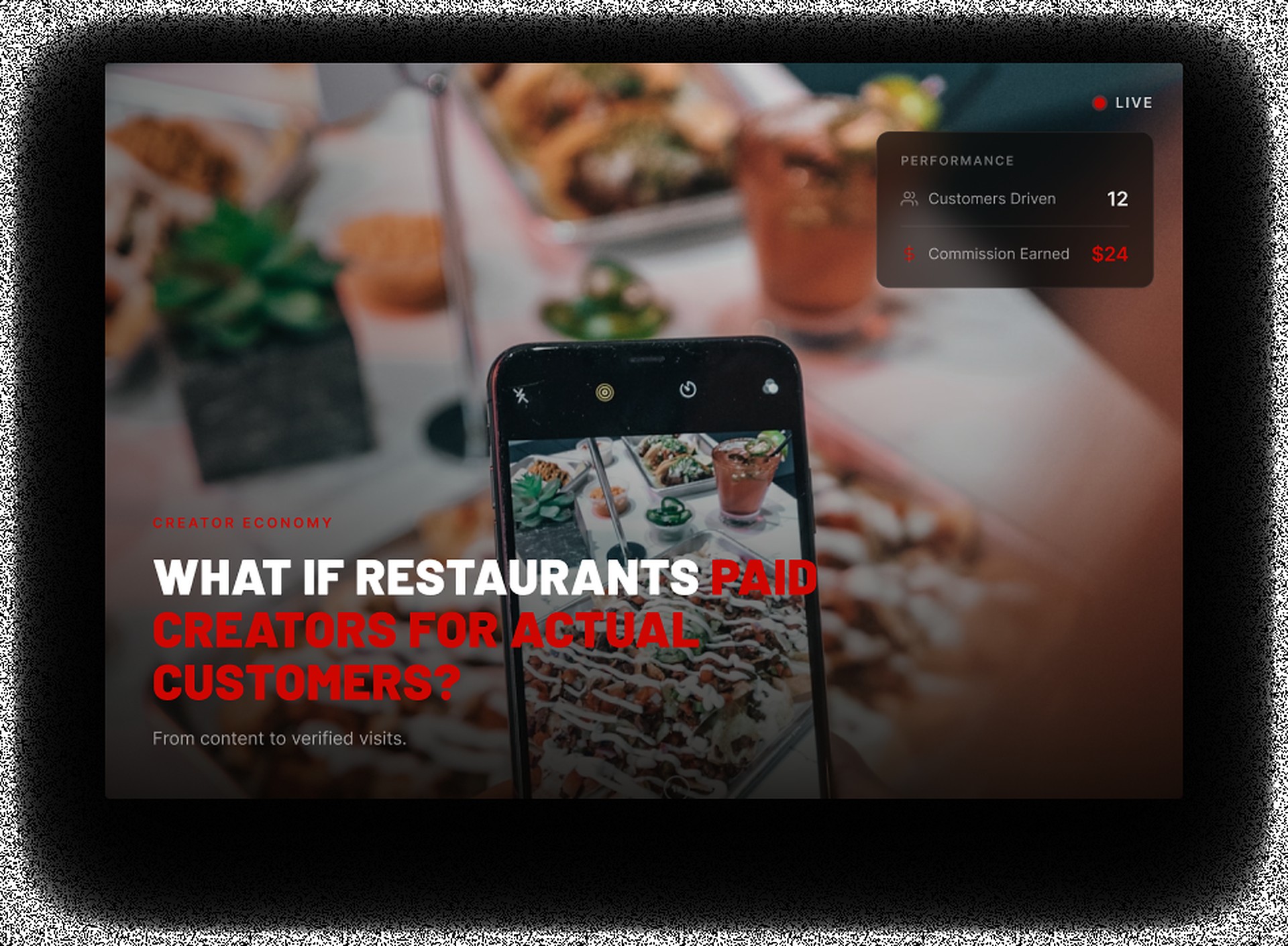
Restaurant influencer marketing usually works like this: pay a creator, they post, and measure the views.
Affiliate marketing changes the equation.
Instead of paying entirely for content, restaurants can reward creators for the customers they actually bring through the door.
The problem? Unlike ecommerce, the conversion usually happens offline. A diner can watch a TikTok today, visit the restaurant three days later, and pay at the counter. There's no natural digital trail connecting those events.
That makes restaurant affiliate marketing fundamentally an attribution problem first and a commission problem second.
Here's how performance-based influencer payouts can work for restaurants, how to structure them, and what we've learned from tracking real restaurant creator campaigns.
What Is Affiliate Marketing for Restaurants?
Affiliate marketing for restaurants means compensating creators based, at least in part, on the customers they actually drive.
A traditional collaboration might look like:
Restaurant → pays creator $300 → creator posts
A performance-based collaboration adds another layer:
Creator → diner discovers restaurant → diner claims offer → diner visits → visit is verified → creator earns commission
For example, a restaurant might offer a creator:
a hosted meal or content fee
$2 for every verified first-time customer
up to $50 in affiliate commissions
If the creator drives 20 verified customers, they earn $40 in commissions. If they drive 25 or more, they reach the $50 commission cap.
This gives restaurants something that's often missing from traditional influencer marketing: a direct relationship between creator compensation and measurable customer acquisition.
But none of this works unless the restaurant can verify that the customer actually showed up.
Why Restaurant Affiliate Marketing Is Different From E-commerce
Affiliate marketing is relatively straightforward online.
A fashion creator shares a link to a pair of shoes. Someone clicks the link, buys the shoes online, and the ecommerce platform records the transaction.
The merchant knows which affiliate generated the sale and can calculate the commission.
Restaurants don't have that natural trail.
A restaurant customer might:
Watch a creator's TikTok on Monday.
Click a link and become interested.
Decide to visit later that week.
Walk into the restaurant on Saturday.
Pay at the restaurant.
The actual conversion happened offline.
A view isn't a customer.
A click isn't necessarily a customer.
Even someone claiming an offer isn't necessarily a customer until they actually visit.
For restaurant affiliate marketing to work, there needs to be an attribution event connecting the person who discovered the restaurant through the creator to the person who ultimately walked through the door.
Attribution first. Commission structure second.
Without that, you've created a performance-based compensation model without a reliable way to measure performance.
The Problem With Paying Only for Content
The standard restaurant influencer deal is often a flat fee: you pay a creator $300, they post, and you both hope.
There's nothing inherently wrong with that.
If your goal is producing content, generating awareness, or creating assets your restaurant can reuse, a flat fee can make perfect sense.
The problem is treating a content fee as though you're buying customer acquisition.
Once the creator publishes the agreed-upon content, they've completed their deliverable whether the video generates 500 views or 500,000 and whether it generates zero restaurant visits or 50.
We've seen why this distinction matters in our own campaign data.
A smaller creator drove significantly more customers
At HAAM Caribbean in NYC, a partner restaurant on DishPair, four creator collaborations generated 37 verified tables.
But those visits weren't distributed evenly.
One creator with 15× fewer followers drove 5× more verified first-time customers than a creator with more than 30,000 followers.
If you evaluated those collaborations primarily through follower count, reach, or even views, you could come away with a very different conclusion about which creator was most valuable.
That's why we think restaurants should separate two things:
Flat fees pay creators for content.
Affiliate commissions reward creators for customer acquisition.
And the two don't have to be mutually exclusive.
How Do You Track Customers From Food Influencers?
A workable restaurant affiliate program needs a verified redemption event.
One approach is giving every creator a unique claim link.
The customer journey could look like:
Creator's video → unique claim link → diner claims restaurant reward → diner visits → reward is redeemed in-store
When the diner redeems the reward, three important things become known:
A real restaurant visit occurred.
The visit can be attributed to a specific creator.
The restaurant knows how much commission that creator earned.
This is substantially more useful for customer acquisition than measuring clicks alone.
Imagine:
Creator A: 100 link clicks → 3 verified tables
Creator B: 40 link clicks → 10 verified tables
Creator A generated more traffic.
Creator B generated more customers.
If the restaurant's goal is customer acquisition, those are very different outcomes.
The Four Pieces of a Working Restaurant Affiliate Program
Once attribution exists, the actual affiliate program becomes much easier to structure.
1. Verified redemptions
Every creator needs a unique attribution mechanism.
That could be a unique claim link, referral code, offer, or another system that can ultimately be verified when the diner visits.
The important distinction is that performance compensation should be connected to a real conversion event, not simply a view or click.
2. A commission per verified customer
The restaurant then determines what a successful referral is worth.
For example:
$2 per verified first-time customer
Fixed commissions are often easier to operate than percentages of the restaurant bill.
If you promise a creator 10% of attributed revenue, you need to connect each diner to a specific transaction and reconcile the appropriate bill amount.
A fixed amount per verified visit can be much simpler.
3. A commission cap
Restaurants should strongly consider setting a maximum performance budget.
For example:
$2 per verified customer, capped at $50.
Now the restaurant knows the maximum affiliate commission it can owe before the campaign even begins.
4. Creator payout infrastructure
Finally, creators need to actually get paid.
That means collecting payment information, tracking commissions, processing transfers, and handling failed or incomplete payouts.
It's relatively easy to handle this manually with two creators.
It becomes much harder with 20 or 100.
What Could a Restaurant Creator Deal Actually Look Like?
Here's a simple hypothetical structure:
Example Restaurant Creator Collaboration
ComponentCompensationHosted mealUp to $100Content fee$150Affiliate commission$2 per verified first-time tableCommission cap$50Maximum cash compensation$200Creator deliverable1 short-form video
The restaurant gets the content it wants while giving the creator additional upside for generating customers.
Another restaurant might eliminate the content fee entirely and offer a larger commission.
Or it might pay a higher content fee to an established creator while keeping a smaller performance component.
There's no universal structure.
The important part is understanding what each component is paying for.
Flat Fee vs. Affiliate Commission: Which Is Better?
Neither is universally better because they're designed to purchase different outcomes.
Hosted meal: You're primarily paying for the creator's experience and content.
Flat content fee: You're primarily paying for content production and distribution.
Affiliate commission: You're primarily paying for measurable customer acquisition.
Flat fee + commission: You're paying for both content and customer acquisition.
If your goal is beautiful content for your restaurant's social channels, paying a flat fee can be entirely appropriate.
If your goal is measurable customer acquisition, adding performance compensation becomes much more interesting.
For many restaurants, a hybrid structure can provide the best balance.
Commission-Only vs. Flat Fee + Commission
Pure commission creates the cleanest incentive alignment.
The creator makes more money when the restaurant gets more customers.
But it's also the hardest structure to sell to established creators.
Creators have real production costs. They have to travel to the restaurant, film, edit, write captions, publish, and potentially give up another paid opportunity.
An established creator may already have restaurants willing to guarantee them a content fee.
That's why a practical structure can be:
Hosted meal + commission
Useful for smaller or emerging creators who already want to experience the restaurant.
Content fee + commission
Useful for established creators whose content itself has meaningful value.
Commission only
Potentially useful for creators participating in an ongoing affiliate program without guaranteed content deliverables.
A hybrid structure lets restaurants recognize the value of the creator's work while still rewarding measurable results.
It also creates better information over time.
If certain creators repeatedly drive customers, restaurants can allocate more budget toward working with them again.
Why Commission Caps Matter
The obvious concern with performance-based compensation is:
What happens if the campaign works too well?
Suppose a restaurant agrees to pay $3 per verified customer.
It expects 10 customer.
Instead, the video takes off and generates 150.
The restaurant suddenly owes $450.
That's arguably a great marketing problem to have, but restaurants operate on tight margins and should still understand their maximum acquisition spend before launching a campaign.
A cap makes that predictable.
For example:
Commission: $3 per verified customer
Maximum commission: $75
The restaurant's maximum performance budget is $75.
If the campaign doesn't generate customers, it doesn't spend the entire $75.
If the creator performs exceptionally well, they can earn the entire amount.
One important distinction:
The cap should stop additional commission billing, not the customer experience.
If a diner arrives with a valid reward after the creator has reached the commission cap, the restaurant shouldn't suddenly reject it.
The customer shouldn't know or care that a marketing budget has been exhausted.
How Much Commission Should Restaurants Pay Food Influencers?
There's no universal number.
Restaurants should work backward from what acquiring a new customer is worth.
Consider:
average check size
restaurant margins
first-time vs. existing customers
likelihood of repeat visits
average customer lifetime value
existing customer acquisition costs
value of collecting first-party customer information
A fast-casual restaurant with a $20 average check probably shouldn't use the same commission structure as a restaurant where the average table spends $150.
And importantly, the value of acquiring a new restaurant customer isn't necessarily limited to the first transaction.
If a creator drives a diner who visits once and spends $25, that's one thing.
If that diner returns six more times over the next year, the economics look completely different.
That's why restaurant affiliate marketing becomes particularly interesting when acquisition and loyalty are connected.
What Performance-Based Restaurant Influencer Marketing Looks Like in Practice
At Wok Wok in Chinatown, three creator videos across TikTok and Instagram generated 9 verified tables and 37 identified first-party contacts in July 2026.
Nine tables isn't a massive number.
That's exactly why the data is useful.
Without attribution, those campaigns might primarily be reported through impressions, views, likes, and engagement.
With attribution, the conversation becomes much simpler:
How many customers actually came in?
And from there:
How much did it cost to acquire each one?
The first-party customer data matters too.
Across two restaurant campaigns we've tracked:
HAAM generated 132 identified customers and 37 verified tables
Wok Wok generated 37 identified customers and 9 verified tables
Those identified diners create another opportunity: the restaurant can potentially re-engage them and turn a creator-driven discovery into a repeat customer relationship.
A note on the data: These are early DishPair campaign results across a small number of restaurants and creator collaborations. They're useful examples of what attribution can reveal, but they shouldn't be treated as restaurant industry benchmarks.
Restaurant Affiliate Marketing Gets More Interesting When You Add Loyalty
This is where restaurant affiliate marketing starts looking different from traditional ecommerce affiliate marketing.
A creator doesn't necessarily generate only a transaction.
They can generate a new customer relationship.
Imagine this journey:
Creator video
↓
Diner claims a restaurant reward
↓
First visit is verified
↓
Creator earns commission
↓
Diner joins the restaurant's loyalty experience
↓
Restaurant encourages another visit
↓
Diner becomes a regular
Now the restaurant can eventually move beyond asking:
Which creator drove the most first-time visits?
Toward a much more interesting question:
Which creators acquire customers who actually come back?
Imagine Creator A generates 20 new customers but almost none return.
Creator B generates 12, but six become repeat customers.
Creator A may look better when measuring first visits.
Creator B could be substantially more valuable when measuring customer lifetime value.
That's where creator marketing starts becoming a true customer acquisition channel rather than simply a content channel.
How to Set Up an Affiliate Program for Your Restaurant
If you want to experiment with performance-based creator payouts, start simple.
1. Get attribution working first
Give each creator a unique way for diners to claim an offer and ultimately verify their restaurant visit.
Nothing else matters until you can reliably measure the conversion.
2. Define exactly what counts as a conversion
Is it:
a link click?
an offer claim?
an in-store redemption?
a verified table?
a first-time customer?
an attributed transaction?
Define this before the collaboration begins.
For customer acquisition campaigns, the strongest verifiable event you can reliably measure will usually be more meaningful than clicks or claims.
3. Determine what a new customer is worth
Look at your average check, margins, repeat behavior, and what you're already willing to spend through other acquisition channels.
4. Choose a commission structure
A fixed dollar amount per verified customer is relatively easy to understand and administer.
More sophisticated programs can eventually experiment with revenue percentages or different commissions for different customer behaviors.
5. Establish a cap
Choose a maximum performance budget you'd be comfortable paying in full.
A successful campaign shouldn't create a financial surprise.
6. Decide whether to include a content fee
This can vary by creator.
An emerging creator may accept a hosted experience plus commission. An established creator may require guaranteed compensation.
7. Establish payout terms before launching
Creators should understand:
what generates a commission
how commissions are calculated
whether there's a cap
when commissions become eligible
when payouts occur
Most compensation disputes become much easier to avoid when the definitions are clear upfront.
8. Build your own creator performance history
Over time, stop asking only:
How many followers does this creator have?
Start asking:
What happened the last time we worked with them?
That's much more useful.
Common Mistakes With Restaurant Affiliate Programs
Paying commissions for clicks
A click indicates interest.
It doesn't necessarily indicate a restaurant customer.
If customer acquisition is the objective, measure as close to the actual visit as possible.
Not defining what "verified" means
The restaurant and creator should understand exactly what triggers a commission before the campaign begins.
Creating unlimited acquisition costs
Performance-based compensation doesn't need to mean unpredictable spending. A reasonable cap can make costs much easier to manage.
Ignoring the value of creator content
Performance marketing doesn't mean creators' time suddenly has no value.
Strong creators may reasonably require guaranteed compensation in addition to performance upside.
Measuring only the first transaction
If a creator acquires a diner who becomes a regular, evaluating the campaign solely against the first check can understate the value of that acquisition.
Choosing creators entirely by follower count
Audience size tells you something about potential distribution.
It doesn't tell you how many people will actually walk into the restaurant.
Our early campaign data has already shown that a substantially smaller creator can outperform a larger one on verified customer acquisition.
When Restaurant Affiliate Marketing Doesn't Make Sense
Performance-based creator compensation isn't right for every campaign.
If you're hiring a creator primarily to produce beautiful photography, create reusable social assets, or generate awareness around a launch, paying them for content may be the right approach.
Affiliate-style compensation also doesn't work particularly well if you can't reliably verify visits.
And restaurants need to think about operational capacity.
A campaign that successfully sends dozens of first-time diners into a restaurant that can't handle them can backfire.
If those customers encounter excessive waits, unavailable menu items, or poor service, successful marketing can create bad first impressions at scale.
Customer acquisition only becomes valuable when the restaurant can turn the acquired customer into a good experience and ideally, another visit.
The Future of Restaurant Influencer Marketing Is Measurable
Views aren't useless.
Neither are likes, reach, engagement, or follower count.
They tell restaurants something about the distribution and resonance of creator content.
But they don't answer the question restaurant operators ultimately care about:
Did this marketing bring me customers?
Performance-based creator payouts create a way to connect creator compensation to that outcome.
The challenge is that restaurant transactions happen offline. Before restaurants can build meaningful affiliate programs, they need a reliable mechanism connecting creator discovery to an actual visit.
Once that exists, the possibilities become much more interesting.
Restaurants can understand customer acquisition cost by creator.
Creators can earn more when they generate results.
Restaurants can spend more confidently with creators who repeatedly drive customers.
And eventually, restaurants can measure not only which creators drive first visits, but which creators acquire customers who become regulars.
That's a much more powerful way to think about restaurant influencer marketing.
How DishPair Helps Restaurants Measure Creator-Driven Customers
DishPair helps restaurants turn creator marketing into measurable customer acquisition.
Each creator can send diners through a unique campaign experience where they claim a restaurant reward. When the diner visits and redeems in-store, the restaurant can attribute that verified visit back to the creator who drove it.
That means restaurants can evaluate creator collaborations based on actual customer activity rather than relying exclusively on views and engagement.
But the first visit is only the beginning.
DishPair connects creator acquisition with rewards, loyalty, first-party customer data, and repeat-visit tracking, helping restaurants understand not only which creators drive customers, but whether those customers come back.