
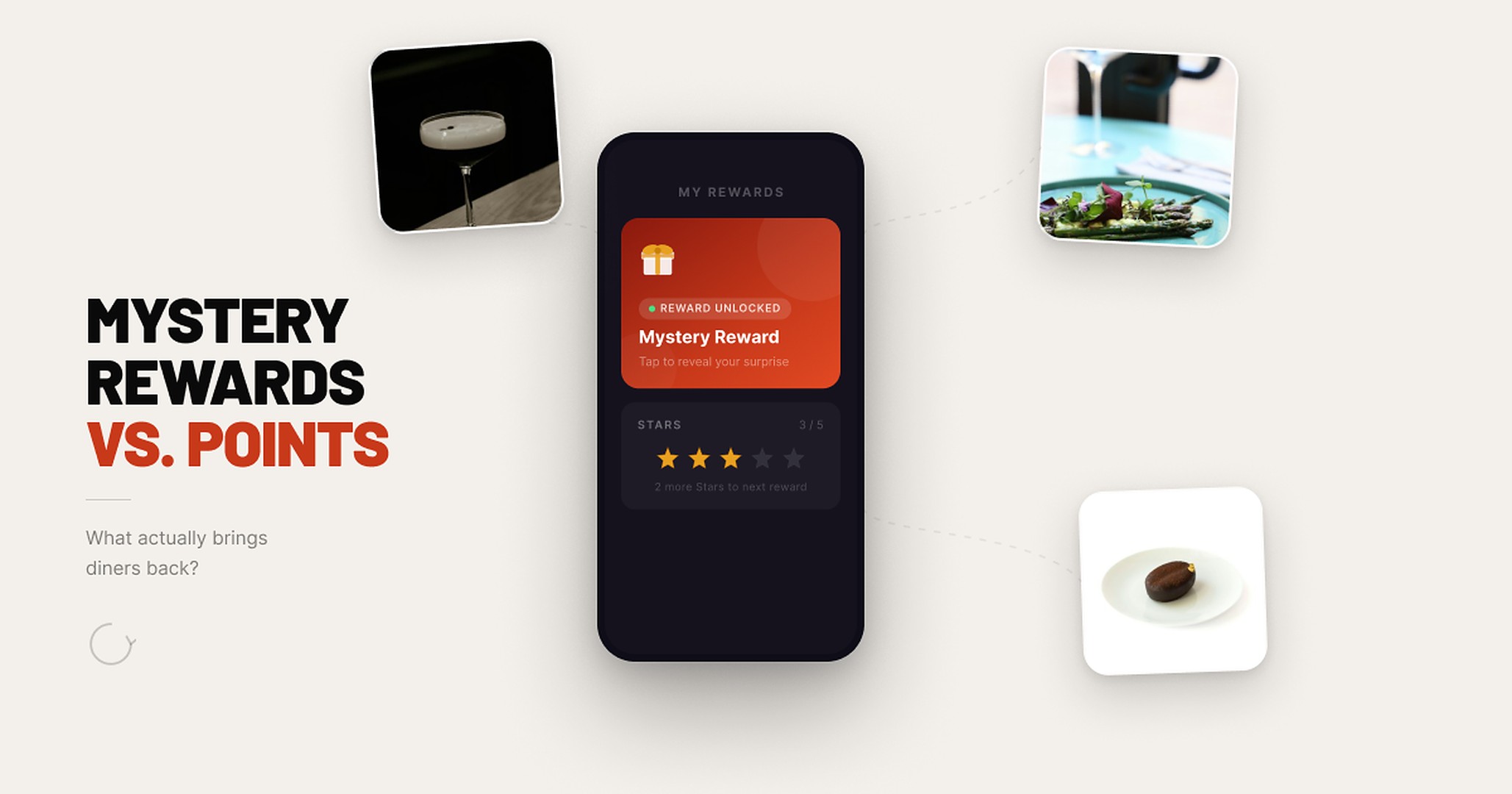
Restaurant loyalty programs usually follow a familiar formula:
Spend money. Earn points. Get a reward.
But points aren't the only way restaurants can encourage customers to come back.
Another approach is the mystery reward.
Instead of immediately telling customers what they'll receive, restaurants give them a reward to unlock.
Maybe it's a free drink.
Maybe it's an appetizer.
Maybe it's 20% off.
Maybe it's something even better.
So which is better for restaurant loyalty: mystery rewards or points?
The answer isn't necessarily one or the other.
They solve different problems.
Mystery rewards create curiosity.
Points and stars create progression.
And strategic rewards can introduce diners to more of your menu, giving them additional reasons to return and potentially increasing how much they spend on future visits.
This guide breaks down how each approach works, when to use it, and how restaurants can combine them.
Mystery Rewards vs. Points: What's the Difference?
The biggest difference is when the reward motivates the customer.
Points are designed around long-term progression.
A customer might earn:
20 points today → 40 points next visit → 60 points → eventually unlock a reward
Mystery rewards create something more immediate.
Instead of waiting several visits for something to happen, the customer has a reward waiting to be discovered.
That means the two approaches can serve different purposes.
Points: Give customers something to work toward.
Mystery rewards: Give customers something to discover.
Best for points: Frequent customers who can make meaningful progress quickly.
Best for mystery rewards: Creating excitement around an offer or giving customers an immediate reason to engage or return.
Restaurants don't necessarily have to choose between them.
They can use both.
How Do Restaurant Points Programs Work?
A points-based restaurant loyalty program rewards customers for spending money or making visits.
For example:
$1 spent = 1 point
100 points = $10 reward
Another restaurant might use visits:
1 visit = 1 stamp
10 stamps = free entrée
The exact system varies, but the basic idea is:
Visit → Earn → Progress → Reward
Every purchase moves the customer closer to something.
That visible progress can give customers another reason to choose the same restaurant again.
When Do Restaurant Points Programs Work Best?
Points can work especially well when customers visit frequently.
Think about someone who buys coffee four times per week.
Their progress might look like:
6 visits → 7 visits → 8 visits → 9 visits → free coffee
The reward always feels relatively close.
That's why progression-based loyalty can be particularly useful for:
Coffee shops
Fast-casual restaurants
Bakeries
Bubble tea shops
Dessert concepts
Lunch spots
Other high-frequency restaurants
The more frequently customers visit, the easier it is for them to see meaningful progress.
What Are the Limitations of Restaurant Points Programs?
Points can become less motivating when the reward feels far away.
Imagine someone visits a full-service restaurant for the first time.
They earn:
20 points.
But they need:
200 points to unlock a reward.
They've made progress.
But if they normally visit restaurants like yours once every few weeks, the reward could still be months away.
That creates a gap.
The customer has a reason to keep visiting over the long term.
But they may not have a particularly strong reason to make their next visit.
This is where mystery rewards can serve a different purpose.
What Are Mystery Rewards?
A mystery reward gives customers an offer without immediately revealing exactly what they'll receive.
Instead of:
Come back for 10% off.
the restaurant might say:
You have a mystery reward waiting. See what you unlocked.
The reward could be:
A free drink
A free side
A free dessert
A free appetizer
A percentage discount
A dining credit
Another restaurant-selected offer
The restaurant controls which rewards are available.
The customer simply doesn't know which one they'll receive before revealing it.
That makes the reward itself part of the experience.
Can Restaurants Control the Cost of Mystery Rewards?
Yes.
“Mystery” doesn't mean the restaurant loses control over what it gives away.
A restaurant could offer smaller rewards more frequently and larger rewards less often.
For example:
Common rewards: Free soft drink, side, or dessert
Occasional rewards: Free appetizer or percentage discount
Rare rewards: Free entrée or larger dining credit
The exact reward mix should depend on the restaurant's menu, margins, and goals.
The key distinction is:
The restaurant controls the economics. The customer experiences the surprise.
Why Do Mystery Rewards Work Differently From Discounts?
Consider these two offers.
Offer A:
Come back this week and get 10% off.
Offer B:
You have a mystery reward waiting. See what you unlocked.
Both give the customer an incentive.
But they lead with different motivations.
A guaranteed discount leads with:
Savings.
A mystery reward leads with:
Curiosity.
That gives restaurants another way to engage customers without making every loyalty interaction another percentage-off promotion.
Guaranteed discounts still have their place.
They're particularly useful when the restaurant wants to drive a very specific behavior, such as:
Visiting during a slower service period
Returning before a deadline
Reactivating an inactive customer
Trying a specific promotion
Mystery rewards simply add another option.
Are Mystery Rewards Better Than Points?
Not necessarily.
They solve different parts of the loyalty problem.
Imagine someone visits your restaurant for the first time and earns:
20 out of 200 points.
They've started progressing toward something.
Now imagine they also receive:
A mystery reward for their next visit.
Suddenly there are two motivations.
The mystery reward gives them something immediate to discover.
The points give them something longer-term to build toward.
The customer journey can become:
First visit → Mystery reward → Return → Earn progress → Future reward
That's why a restaurant doesn't necessarily need to ask:
“Should I use mystery rewards or points?”
A better question is:
“What should motivate the next visit, and what should motivate the visits after that?”
How Can Restaurant Rewards Encourage Menu Discovery?
Rewards don't only have to encourage customers to return.
They can also encourage customers to try more of your menu.
Imagine someone discovers your restaurant because they saw your signature burger on TikTok.
They visit.
They order the burger.
They love it.
But they still know almost nothing about the rest of your menu.
Instead of giving them a generic:
10% off your next visit
you could introduce them to something else.
For example:
Try our signature drink
Unlock a complimentary appetizer
Discover one of our most popular desserts
Try a new seasonal menu item
Now the reward does two jobs.
It gives the customer a reason to return.
And it gives them something new to discover when they do.
Why Can Menu Discovery Increase Repeat Visits?
The more dishes a customer loves, the more reasons they may have to return.
Consider a customer who originally knows your restaurant for one dish:
“That's the place with the great burger.”
A reward brings them back and introduces them to an appetizer.
Another visit introduces them to a signature drink.
Now they might think:
“I love their burger, their appetizer is great, and I want that drink again.”
The restaurant is no longer associated with one product.
The customer has multiple reasons to return.
That creates a simple retention loop:
Reward → Discovery → Preference → Return
For restaurants with large or varied menus, loyalty can become a tool for helping customers discover more of what makes the restaurant worth coming back to.
Can Restaurant Loyalty Rewards Increase Average Order Value?
They can potentially contribute to higher average order value over time.
Suppose a customer normally orders:
One entrée.
Then a reward introduces them to your signature appetizer.
They try it.
They love it.
The next time they visit, they may decide to purchase it themselves.
Their order could become:
Appetizer + entrée
instead of:
Entrée
The same could happen with:
Entrée + cocktail
Entrée + dessert
Entrée + side
The restaurant initially uses the reward to generate trial.
If the customer likes the item, future visits create opportunities for full-price purchases.
The goal isn't simply to give away more food.
It's to introduce customers to products they may want to purchase again.
What Menu Items Should Restaurants Offer as Loyalty Rewards?
The most expensive item isn't necessarily the best reward.
Restaurants should think about what they want customers to discover.
Good candidates could include:
High-margin signature drinks
Popular appetizers
Desserts customers often skip
New seasonal dishes
New menu categories
Items that pair well with popular entrées
Products customers are likely to reorder after trying
For example, giving away a small signature appetizer could be more valuable than giving 15% off the entire check if customers who discover that appetizer later begin ordering it regularly.
The question shouldn't only be:
“What can we give away?”
It should also be:
“What could we introduce this customer to that they might want again?”
What Restaurant Loyalty Strategy Should You Use?
Different loyalty mechanics are useful for different goals.
Points or Stars
Best for: Long-term progression
Use them when customers visit frequently enough to see meaningful progress toward future rewards.
Mystery Rewards
Best for: Immediate engagement and return motivation
Use them when you want the customer to have something interesting to discover or another reason to make their next visit.
Menu-Specific Rewards
Best for: Menu discovery and potential future spending
Use them to introduce customers to drinks, appetizers, desserts, seasonal dishes, or other products they haven't tried.
Guaranteed Discounts
Best for: Driving a specific action
Use them when you want to fill a slow period, reactivate an inactive customer, or encourage a visit before a deadline.
These strategies don't need to operate independently.
A restaurant can use different incentives at different points in the customer journey.
How DishPair Combines Mystery Rewards, Stars, and Menu Discovery
DishPair combines these loyalty mechanics into one customer journey.
Instead of choosing between immediate rewards and long-term progression, restaurants can use mystery rewards, stars, and menu discovery together.
A diner might first discover a restaurant through a DishPair offer.
The offer can contain a mystery reward selected from rewards the restaurant makes available.
That reward can also introduce the diner to a specific part of the menu.
The customer visits and tries something new.
They can then earn stars as they continue visiting, creating longer-term progression toward future rewards.
The journey becomes:
Discover → Unlock → Visit → Explore → Earn Stars → Return
Each part has a different job.
Mystery rewards create curiosity.
Stars create progression.
Menu discovery creates more reasons to return.
And because DishPair can connect creator-driven offers with verified restaurant visits, restaurants can connect customer acquisition with what happens after that first visit.
Instead of the creator journey ending at:
Creator → Content → Views
it can become:
Creator → Offer → Verified first visit → Loyalty → Repeat visits
The creator helps acquire the customer.
Mystery rewards and menu discovery give them reasons to engage with more of the restaurant.
Stars give them something to keep progressing toward.
The Bottom Line
So, should restaurants use mystery rewards or points?
You don't necessarily have to choose.
They solve different problems.
Mystery rewards create curiosity.
Points and Stars create progression.
Menu discovery creates more reasons to return.
Restaurants can use mystery rewards to encourage an immediate action, stars to build long-term loyalty, and strategic menu rewards to introduce diners to products they may eventually purchase themselves.
The goal isn't simply to give customers discounts.
It's to turn one restaurant visit into the beginning of a longer customer relationship.
For restaurants using DishPair, that journey can look like:
Discover → Unlock → Visit → Explore → Earn Stars → Return
Because getting a new customer through the door matters.
Giving them more reasons to keep coming back is what turns acquisition into retention.