
What Does Restaurant Influencer Marketing Actually Cost in 2026?
Ask three restaurant owners what influencer marketing costs and you might get three completely different answers:
“A few thousand dollars a month.”
“A free meal.”
“Nothing. I just DM creators myself.”
All three can be right.
That's because restaurants aren't necessarily paying for the same thing.
There are three main ways to run restaurant influencer marketing in 2026: hire an agency, use a creator marketing platform, or manage everything yourself.
The sticker price is the easy part to compare. The bigger differences are how much work lands on your team, what you pay creators, and whether you can tell which collaborations actually brought customers through the door.
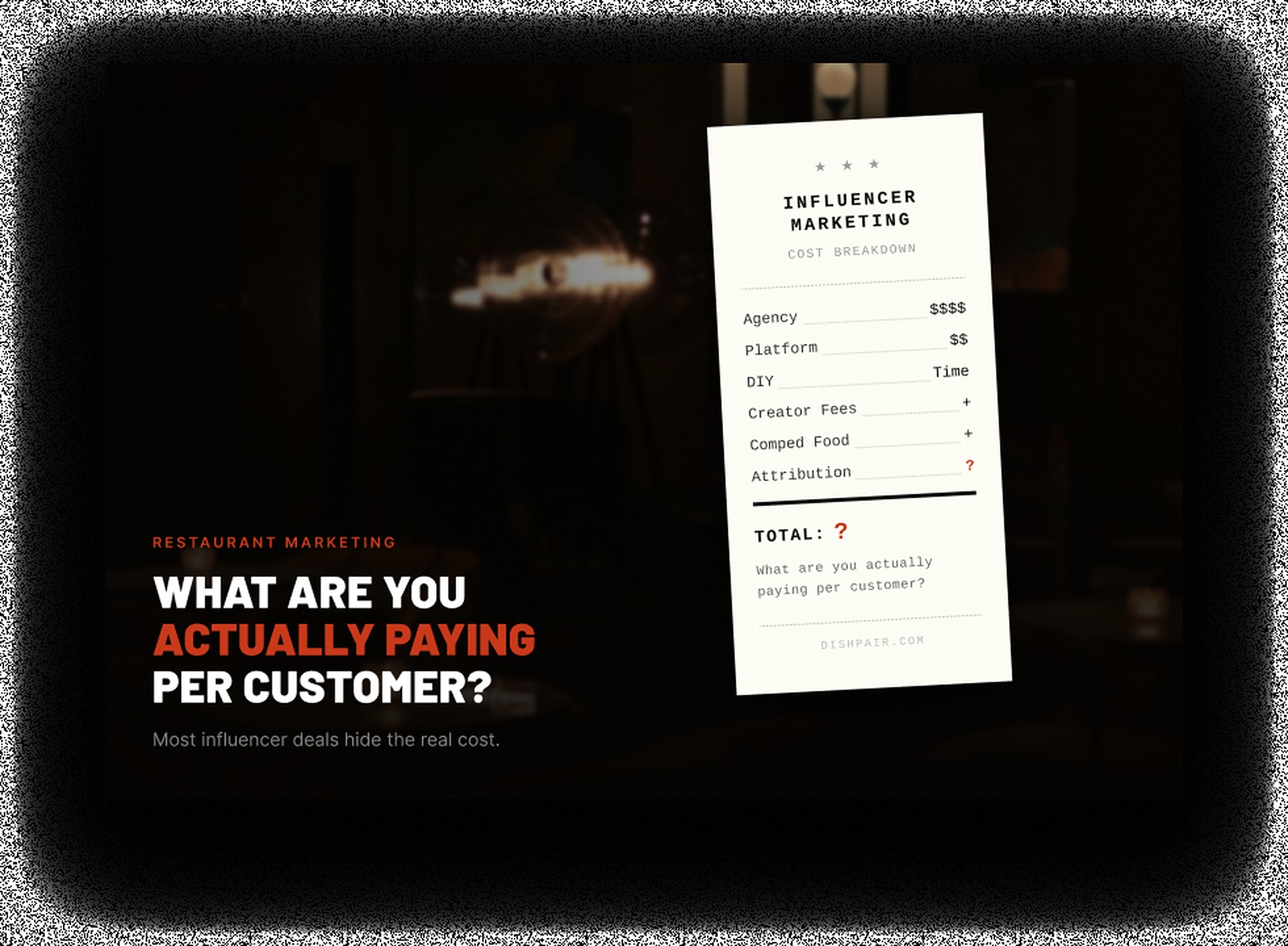
The Four Costs Behind Restaurant Influencer Marketing
Regardless of how you run your program, there are four potential costs to think about.
1. Management
Someone has to find creators, vet them, conduct outreach, negotiate terms, coordinate schedules, send reminders, and make sure content actually gets posted.
With an agency, you're paying a retainer for this work. With a platform, it's typically included in the subscription. With DIY, you're paying with your own time.
2. Creator compensation
Creators may collaborate in exchange for a hosted meal, charge a guaranteed fee, earn performance-based compensation, or receive some combination of the three.
This cost is often separate from whatever you're paying an agency or platform.
3. The offer
There's also the cost of what you're giving away.
That might simply be the creator's hosted meal. But if their followers can claim a free appetizer, mystery reward, discount, or other promotion, those redemptions have a real cost too.
4. Measurement
Finally, there's attribution.
Which creator generated customers? How many people actually visited? What did it cost to acquire each one? Did any of them come back?
This is the cost restaurants often overlook because the absence of measurement doesn't appear as a line item on an invoice.
But without it, you're spending money without knowing what produced a return.
Option 1: Hiring a Marketing Agency
Hiring an agency is usually the highest-cost option, but it can also remove the most work from your team.
Depending on the agency and scope, restaurant marketing retainers can run into several thousand dollars per month. Creator compensation may or may not be included.
In return, an agency might handle creator sourcing, outreach, briefing, scheduling, campaign management, content strategy, and reporting.
For restaurants considering an agency, there are three important questions to ask.
Is creator compensation included?
Don't assume that the retainer includes what creators themselves charge. Hosted meals, creator fees, and other campaign costs may sit on top of the monthly retainer.
What's the minimum commitment?
If there's a three- or six-month contract, calculate the total commitment rather than comparing a single month's retainer.
How is success measured?
Many influencer reports focus heavily on impressions, reach, engagement, and follower growth.
Those numbers can be useful, especially when brand awareness is the goal. But if your goal is customer acquisition, ask whether the campaign can also connect individual creators to actual restaurant visits.
An agency can make sense for restaurant groups that want broader marketing support, have a meaningful marketing budget, and value having an outside team manage strategy and execution.
Option 2: Using an Influencer Marketing Platform
A platform changes the cost structure.
Instead of paying a large monthly retainer, restaurants typically pay a software or service subscription.
DishPair, for example, starts at $150 per month.
But the important distinction isn't simply "$150 versus a $2,500 retainer." It's what the restaurant still has to do after paying.
With DishPair, creator sourcing and vetting, outreach, scheduling, reminders, deliverable tracking, and creator payouts are managed through the platform and team.
The restaurant primarily decides what it wants to offer creators and customers, approves collaborations, and hosts the visits.
Creator compensation remains separate. Depending on the campaign, that might mean a hosted experience, guaranteed creator fee, performance payout, or a combination.
The other major difference is attribution.
Instead of ending the campaign when a Reel or TikTok goes live, the campaign can continue through the customer's actual visit, allowing the restaurant to see which creators generated measurable customers.
Option 3: Doing It Yourself
DIY influencer marketing looks free.
There's no agency retainer. There's no platform subscription. You might simply invite a creator in, comp their meal, and ask them to post.
For a restaurant testing influencer marketing for the first time, that can be perfectly reasonable.
But the real cost is owner or manager time.
Someone still has to:
Find relevant local creators
Determine whether their audience is actually local
Check engagement and content quality
Send outreach
Follow up with creators who don't respond
Negotiate compensation and deliverables
Coordinate visits around restaurant service
Track who showed up
Follow up on missing content
Keep track of every collaboration
None of those tasks is particularly difficult by itself.
The problem is that they become dozens of small interruptions spread throughout the week, often landing on the same owner or manager who's already handling staffing, inventory, vendors, reviews, reservations, and service.
And after doing all of that, there's still another problem:
How do you know whether the collaboration generated customers?
DIY can be a great way to test creator marketing with two or three collaborations before committing meaningful budget.
It becomes harder to manage once you want creator marketing to run consistently every month.
The Hidden Cost: Not Knowing What Worked
This is where comparing influencer marketing purely on monthly price gets misleading.
Imagine two creators each receive the same $100 hosted experience.
Creator A's video generates 80,000 views and brings four tables into the restaurant.
Creator B's video generates 150,000 views and brings nobody in.
Without attribution, Creator B might actually look like the better collaboration.
That's the hidden cost of influencer marketing without measurement.
You don't just risk wasting money on one campaign. You lose the information you need to make the next campaign better.
Should you work with that creator again?
Should you increase their compensation?
Should you find five more creators like them?
Should you stop spending altogether?
Most restaurant influencer campaigns can tell you what happened online.
The more valuable question is whether your setup can connect what happened online to what happened inside the restaurant.
A Real Example: 7 Posts, 400K Views, 50 Verified Tables
HAAM, a New York City restaurant, ran creator collaborations through DishPair.
Seven creator posts generated approximately 400,000+ views across Instagram and TikTok.
That's impressive reach.
But reach alone doesn't tell the restaurant whether the campaign worked.
The more important result was what happened afterward:
50 verified tables visited the restaurant.
Each visit could be connected back to the creator who drove it.
The campaign also identified 272 customers, giving HAAM customer relationships it could continue engaging rather than simply accumulating views on someone else's social platform.
One customer even returned the following day, just 24 hours after their first visit.
Without attribution, the campaign would have ended with approximately 400,000 views and the same question restaurants have been asking about influencer marketing for years:
Did any of those views actually become customers?
With attribution, HAAM could answer it.
What Do Food Creators Charge Restaurants?
Creator compensation sits on top of whichever operating model you choose.
Nano creators, generally those with roughly 1,000 to 10,000 followers, may collaborate in exchange for a hosted meal or relatively small fee.
Micro creators with larger audiences may expect guaranteed compensation, while established creators can charge hundreds or thousands of dollars depending on their reach, engagement, content quality, platform, usage rights, and deliverables.
Restaurants can also structure compensation around performance.
Instead of paying entirely for the post itself, a restaurant might provide a hosted meal plus a payout for each verified customer the creator generates.
We've broken down creator rates in more detail in our guide to what food influencers charge restaurants.
The important distinction is that creator compensation and campaign management are separate costs.
A $2,000 agency retainer doesn't necessarily mean your campaign costs $2,000.
And a $150 platform subscription doesn't necessarily mean your campaign costs $150.
You need to include creator compensation, offers, and any other campaign costs when calculating the true total.
The Number That Makes Costs Comparable: Cost per Verified Customer
This is where the three approaches become easier to compare.
Don't look only at monthly spend.
Look at what that spend produced.
Suppose you spend $2,500 on influencer marketing and generate a large amount of content and reach, but you can't connect any of it to restaurant visits.
Your cost per verified customer isn't zero.
It's unknown.
Now suppose you spend $150 on a platform subscription plus creator compensation and can verify that 50 tables visited because of those campaigns.
You suddenly have a denominator.
You can calculate customer acquisition cost and compare creator marketing against Meta ads, Google ads, promotions, delivery platforms, or any other customer acquisition channel.
The basic calculation is simple:
Customer Acquisition Cost = Total Campaign Spend ÷ New Customers Acquired
And once you know CAC, you can ask much more useful questions.
What was the average check?
How many customers came back?
Which creators produced the lowest CAC?
Which creators brought the highest-value customers?
That's when influencer marketing stops being something you "hope worked" and becomes something you can optimize.
Which Option Fits Your Restaurant?
Single location and just testing influencer marketing
Start DIY with two or three creators if you're comfortable handling outreach yourself. If you want to skip the coordination and measure visits from the beginning, consider a platform.
You probably don't need a long agency commitment just to determine whether creator marketing works for your restaurant.
Single location and ready to run creators consistently
A platform can make sense when creator marketing becomes an ongoing acquisition channel rather than an occasional collaboration.
The goal is to remove the repetitive coordination while giving you enough attribution to determine which creators are worth working with again.
Multi-location restaurant or restaurant group
Compare platforms and agencies based on what you actually need.
If you need broader brand strategy, content production, PR, or social management, an agency may be the better fit.
If your primary goal is acquiring customers through creators across multiple locations, compare options based on cost per verified customer and location-level reporting, not simply retainer versus subscription.
Already working with creators yourself
You may already have the hardest asset: creator relationships.
Before spending more to acquire additional creators, consider improving your measurement.
Knowing which existing relationships actually drive customers can be more valuable than simply adding more collaborations.
How DishPair Prices Restaurant Influencer Marketing
DishPair starts at $150 per month.
The platform is designed around a simple idea: restaurants shouldn't have to choose between manually managing creators themselves and paying thousands of dollars for influencer marketing they can't directly measure.
DishPair includes:
Customer acquisition through vetted creators and paid ads
Starts at 3 fully managed creator collaborations per month
Creator sourcing, outreach, and scheduling
Verified visit and revenue attribution
Loyalty
Automated SMS marketing
Reputation management
Customer analytics
Creator compensation is separate and depends on the campaign. Restaurants can offer hosted experiences, guaranteed compensation when appropriate, performance-based payouts, or a combination.
And if DishPair isn't a fit after the first month, we refund the subscription fee.
Final Thoughts
So, what does restaurant influencer marketing actually cost?
It depends on what you're paying for.
An agency charges you to outsource the work.
DIY saves the management fee but puts the work on your team.
A platform sits somewhere in between, automating or managing much of the work while giving restaurants the ability to measure what happens after the content goes live.
But the cheapest option isn't necessarily the one with the lowest monthly fee.
The better question is:
How much did you spend, how many new customers did it produce, and which creators should you invest in next?
If you can't answer those questions, you don't really know what your influencer marketing costs yet.
If you'd like to see how DishPair tracks creator campaigns from the post all the way to the restaurant visit, book a demo.