
The short answer
Choose based on who should carry the risk, not simply what you can afford.
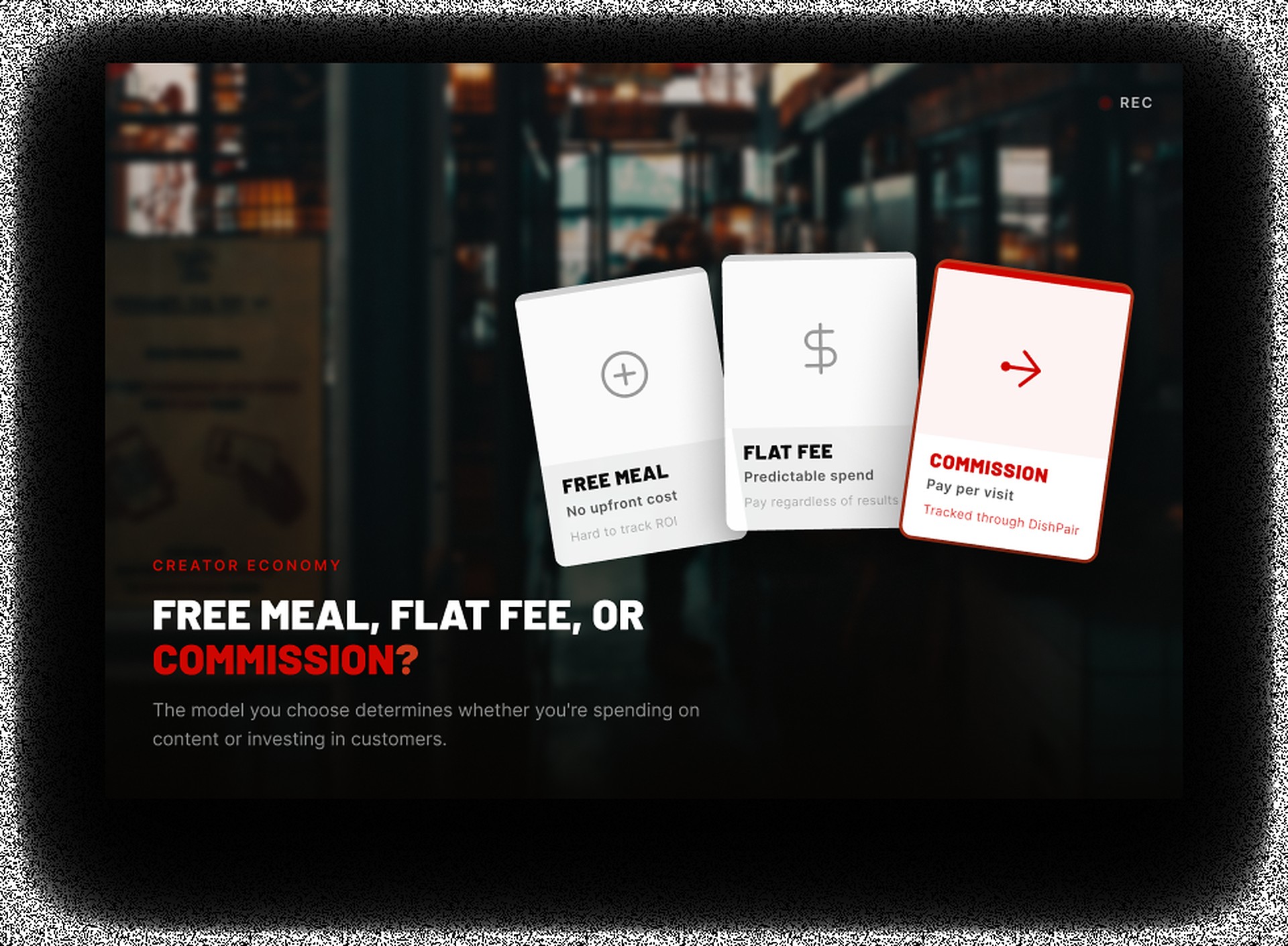
A free meal asks the creator to take most of the financial risk: they spend their time and audience attention in exchange for the dining experience.
A flat fee shifts most of the performance risk to the restaurant. You pay the same whether the content drives four tables or none.
A commission ties compensation directly to results, sharing more of that risk between the restaurant and creator, but only if you can reliably prove which customers came from which creator.
And a hybrid combines guaranteed compensation with performance incentives.
Most restaurants default to whichever model they're most familiar with, then wonder why the results feel arbitrary.
Work through the four questions below and the right structure usually becomes much clearer.
For what each model typically costs, see our food influencer pricing guide. This article is about how to structure creator compensation, not how much to pay.
Four questions that decide it
1. Can you verify that a specific creator sent a specific diner?
If not, commission is difficult to do fairly.
You'd be paying against a number neither side can confidently verify, which is a recipe for disagreements. Fix attribution first, or choose between a hosted meal and a flat fee.
Even if you aren't paying commission, attribution still matters. Knowing which creators actually drive customers gives you better information for deciding who deserves another collaboration.
2. What is a new customer actually worth to you?
Don't think only about their first check.
Think about the value of the first visit plus the probability that customer returns.
A $40 dinner from someone who visits once is worth roughly one transaction. Someone who discovers you through a creator and becomes a monthly regular could be worth hundreds of dollars in revenue over the following year.
You don't need a perfect lifetime-value model. But you should have some idea of what you're willing to spend to acquire a new customer.
That number sets the ceiling for every compensation model.
3. Can your kitchen absorb a cluster of new customers?
A creator campaign that works doesn't necessarily send customers evenly.
A video can suddenly gain traction and send diners over a few days or weekends. If Friday night already strains your kitchen, a successful campaign can create bad first impressions at scale.
And a first-time customer who waits 40 minutes for their food is much less likely to become the repeat customer that justified your acquisition spend in the first place.
Marketing doesn't stop when someone walks through the door.
4. How much leverage does this creator have?
A creator with a reliable local audience, proven results, and multiple inbound offers probably doesn't need another free dinner.
A smaller creator who's still building relationships with restaurants may be happy to collaborate for a hosted experience.
Neither is inherently better.
But this is what determines whether a free meal feels like a worthwhile exchange or an offer that's easy to decline.
What each creator compensation model actually buys
Free meals
Hosted meals can work genuinely, especially with nano and micro creators.
A creator with a few thousand highly engaged local followers may value a great dining experience, interesting content opportunity, and restaurant relationship enough to collaborate without an additional fee.
But what you're primarily buying is access and goodwill, not guaranteed performance.
Unless you've explicitly agreed on deliverables, you shouldn't assume a hosted meal guarantees a specific post, timeline, number of views, or number of customers.
And the model becomes harder as creators gain leverage.
Offer only a comped meal to someone regularly receiving paid briefs and you're competing against opportunities that compensate both their dining costs and their time.
Flat fees
Flat fees buy certainty around the deliverable.
The creator knows what they're getting paid. You know what you're spending. Both sides can agree in advance on the content, platform, timeline, and usage rights.
But you're buying content, not necessarily customers.
Once the fee is agreed upon, the creator gets paid whether the video drives four tables or none.
That's perfectly reasonable when content itself is the objective: a restaurant launch, professional-looking social assets, awareness, photography, or a brand campaign.
It becomes much harder to justify when your real objective is customer acquisition but you're measuring success primarily through views and follower counts.
Affiliate commission
Commission buys alignment.
The creator earns when their content produces a measurable result, so their financial incentive doesn't necessarily stop when the post goes live.
Instead of:
Post → Get paid
the model becomes:
Post → Customers visit → Creator earns
But pure commission comes with an important tradeoff: it's often a harder pitch to established creators.
A creator with guaranteed flat-fee opportunities is being asked to take downside risk on a restaurant and campaign they may never have worked with before.
Some will accept. Many won't.
Commission also requires infrastructure. At minimum, you need:
Reliable creator-level attribution
A clearly defined qualifying action
A payout amount
A payout cap or budget
A way to verify and pay creators
We've written more about the mechanics in our guide to affiliate marketing for restaurants.
The trap all three models share
Whatever structure you choose, the failure mode is often the same:
Paying for audience size instead of business outcome.
We saw this firsthand while running creator campaigns for HAAM Caribbean Plant Cuisine in NYC.
Across four creator collaborations, we tracked 37 verified first-time tables in 30 days.
But the results weren't distributed according to follower count.
One creator with 15× fewer followers drove 5× more verified first-time customers than a creator with more than 30,000 followers.
If we had valued those creators purely according to audience size, we could have paid substantially more for the creator producing substantially fewer customers.
That's one campaign, and we won't pretend it establishes a universal rule.
But it demonstrates something narrower and important:
Follower count and verified customer acquisition can move in opposite directions.
If the metric you're using to price creators can behave that way, you need another metric.
For restaurants trying to acquire customers, the most useful one is simple:
Did people actually show up?
That's an argument for attribution regardless of how you compensate creators.
Even if you prefer flat fees, track visits.
You'll still pay the same amount for this campaign but you'll know which creators are worth paying again for the next one.
What we'd recommend
If you're testing creator marketing and don't have attribution yet:
Start with a hosted meal, primarily with nano and micro creators. Keep the stakes low while learning which creators resonate with your customers.
If you're deliberately buying content for a launch, social assets, or photography:
Use a flat fee. You're paying for the content itself, so evaluate the collaboration on the quality and usefulness of what gets produced.
If you can verify visits and want repeatable customer acquisition:
Use commission, with clearly defined payouts and caps. You're tying more of your spend directly to measurable results.
If you want proven creators and aligned incentives:
Use a hybrid: a hosted experience, a guaranteed creator fee when appropriate, and a performance commission. You can secure creators who command upfront compensation while still rewarding actual customer acquisition.
The hybrid and why we landed on it
Pure commission creates strong alignment but can be a difficult pitch.
Hosted meals are easier to offer but provide less commitment.
Flat fees secure creators but don't inherently reward customer acquisition.
So we landed on a hybrid:
A commission for every verified customer, combined with an optional creator fee negotiated based on the creator and campaign.
That gives restaurants another dial to turn.
Testing an emerging creator?
Start with the hosted experience and performance upside.
Working with a creator who's already demonstrated that they can bring customers through the door?
Pay the content fee necessary to secure the collaboration while keeping the commission so there's still upside tied to results.
The important distinction is that the meal itself isn't necessarily the compensation.
It's hospitality.
And it should be good.
When each model is the wrong answer
Don't rely on a free meal when you need guaranteed deliverables or a post to go live on a specific date. Put those expectations into a clearly agreed collaboration instead.
Don't pay a flat fee without knowing what you're buying. "Exposure" isn't a useful deliverable. Define the content, audience, usage rights, or other objective you're paying for.
Don't offer commission without attribution. If neither side can verify the qualifying customers, neither side can confidently calculate what is owed.
Don't run an uncapped commission program without understanding your economics. Define your acquisition budget, contribution margin, and payout rules before the campaign begins.
And don't use any of these models if your restaurant can't handle the demand you're trying to create.
Every compensation structure above assumes the customer has a good first visit.
None of them can compensate for a bad one.
The bottom line
Free meals, flat fees, and commissions aren't simply three levels of creator compensation.
They're different allocations of risk.
Hosted meals place more risk on the creator.
Flat fees place more performance risk on the restaurant.
Commission ties more of the creator's compensation to results.
And a hybrid lets restaurants secure the creators they want while still rewarding measurable customer acquisition.
So don't start with:
"How little can we pay this creator?"
Start with:
"What are we actually trying to buy?"
If the answer is content, structure the collaboration around content.
If the answer is customers, measure customers.
And if you want both, compensate for both.
Because once you can see which creators actually bring people through the door, influencer marketing stops being a series of one-off posts.
It becomes a customer acquisition channel you can improve every time you run it.