DishPair vs Mustard: Which Is Better for Restaurant Influencer Marketing? (2026)
Pricing, how each works, what you can measure, and which one fits your restaurant: a side-by-side comparison of DishPair and Mustard.
By Thien Nguyen, Founder of DishPair
Quick answer: Mustard is built for restaurants that want a set number of creator posts each month from a very large creator network. DishPair is built for restaurants that want creators managed for them and want to know which creators actually brought in customers, with loyalty and SMS to bring those customers back. If your goal is predictable content volume, Mustard is a strong fit. If your goal is verified customers you can count, DishPair is.
Both platforms help restaurants work with local food creators. They start at similar prices. Where they differ is what happens after the content goes live, how creators get paid, and what you can measure.
This comparison uses Mustard's public pricing page and homepage as of November 2026. Prices change, so check both sites before you decide.
DishPair vs Mustard at a Glance
DishPair | Mustard | |
|---|---|---|
Best for | Restaurants that want creators to bring verified customers, and to keep them coming back | Restaurants that want a set number of creator posts each month |
Starting price | $199/month founding rate (rising to $299) | $299 for a 1-month campaign |
What the starting plan includes | 3 fully managed creator collaborations a month, plus a dedicated account manager | 3 local influencers, 3 posts + 3 stories |
Bigger plans | Growth plan with custom, volume-based pricing for groups and multi-location brands | $499 (5 creators), $999 (10 creators, dedicated strategist), and a 12-month Unlimited plan at $20,000 |
Commitment | Monthly, no long-term contract, 30-day money-back guarantee | 1-month or 3-month campaigns, then cancel anytime |
Creator compensation | Hosted meal, creator fee, or a performance payout per verified customer | Food, cash, or affiliate; cash is separate from the plan price on higher plans |
Creator network | Vetted local food creators who apply to your campaign, plus creators recruited for it | 175,000+ creators across the U.S., Canada, and the U.K. |
What you can measure | Content performance plus verified customer visits and revenue, by creator | Reach, views, engagement, and profile visits, by creator |
Loyalty and SMS | Included | Not listed on Mustard's public pages |
Where it's available | United States | U.S., Canada, U.K. |
How Pricing Compares
DishPair Pricing
DishPair's Starter plan is $199 per month at the founding rate for the first 100 restaurants, then $299. It includes three fully managed creator collaborations a month, a dedicated account manager, creator sourcing and outreach, scheduling and reminders, campaign tracking, verified customer and revenue attribution, and loyalty and SMS.
Creator compensation is separate and up to you: a hosted meal, a guaranteed creator fee, a performance payout for each verified customer, or a mix. The Growth plan covers restaurant groups and multi-location brands with custom pricing.
Mustard Pricing
Mustard prices by campaign length and the number of creators:
Talk of the Town: $299 for a 1-month campaign (3 influencers), or $675 for 3 months (9 influencers)
Campaign Champagne: $499 for 1 month (5 influencers), or $1,125 for 3 months (15 influencers)
High Impact: $999 for 1 month (10 influencers), or $2,250 for 3 months (30 influencers), with a dedicated strategist
Unlimited: $20,000 for 12 months
Each creator delivers a post and a story. Mustard lists creator compensation as food, cash, or affiliate, and notes that cash compensation is separate from the plan price on its higher plans.
The takeaway on price: the entry points are close. The bigger difference is what you're paying for. Mustard's plans are priced around a number of creators and posts. DishPair's are priced around managed collaborations, with tracking of the customers they bring in included.
How Each Platform Works
How Mustard Works
You choose a plan, Mustard matches you with creators from its network (you can also pick them yourself), you approve them, and they visit and post. Mustard says campaigns can launch within 24 hours, guarantees at least three creator applications per campaign (refunding unfilled slots), and flags missed posts in the dashboard so they can be replaced.
Mustard's biggest strength is scale: a network of 175,000+ creators across hundreds of cities in three countries. If you're in a market few platforms cover, or you want a lot of creators quickly, that matters.
How DishPair Works
Creators in DishPair's network apply to your campaign through the DishPair creator app, and DishPair's team recruits more where needed. DishPair vets every creator before they're booked, then confirms the visits, sends reminders, tracks the content, and pays creators. You set the campaign goal and the offer, and you can ask to see the creators before they visit.
Each creator gets a unique DishPair link. Diners who discover you through that creator claim an offer before they visit, then redeem it at the restaurant. That visit is verified and attributed back to the creator who drove it.
The Real Difference: What You Can Measure
This is where the two platforms differ most.
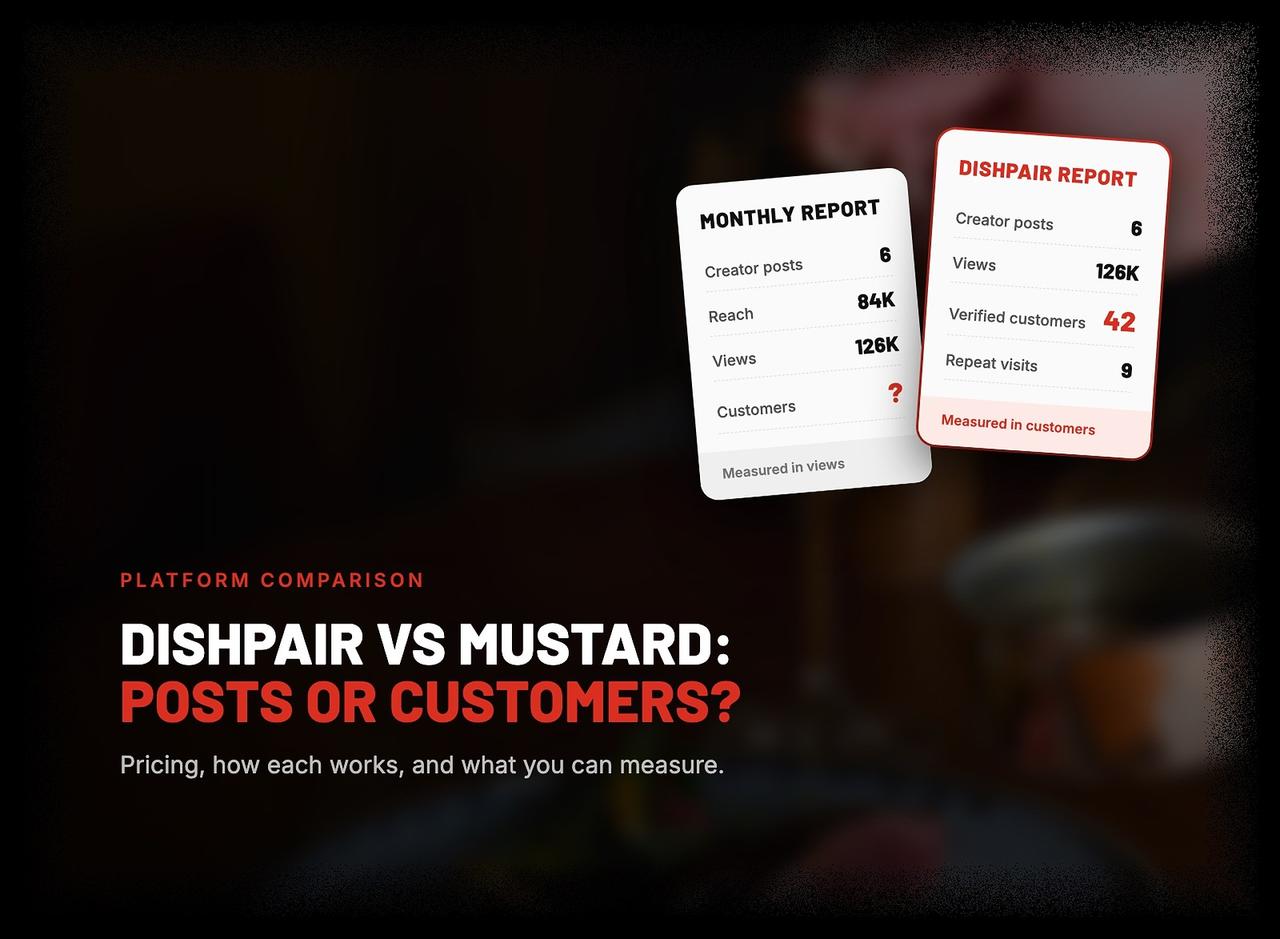
Mustard's dashboard reports reach, views, engagement, and profile visits for each creator, with links to every post. Those are useful numbers for judging content.
DishPair reports content performance too, but its main measure is verified customers: how many diners each creator actually brought through the door, how much they spent, and whether they came back. That's what lets you work out your cost per customer and decide which creators to work with again.
Why it matters: views and customers don't always line up. In one DishPair campaign, a creator with roughly 15× fewer followers drove 5× more verified first-time customers than a much larger creator. If you were judging that campaign on reach alone, you'd have rebooked the wrong creator.
For the full story, read the HAAM case study: 37 verified tables in 30 days from four creator collaborations.
What Happens After the First Visit
A creator campaign that ends at the first visit leaves money on the table. Most of a customer's value comes from coming back.
DishPair includes loyalty (Bite Drops surprise rewards and Stars progress) and automated SMS, so diners who came in through a creator can be brought back, and you can see which creators bring in diners who return. Mustard's public pages don't list loyalty or SMS features.
If you already run a loyalty program elsewhere, this matters less. If you don't, it's a meaningful part of the comparison. See our guide on turning first-time diners into regulars.
How Creators Get Paid
Mustard lists food, cash, or affiliate compensation, with cash paid on top of the plan on its higher tiers.
DishPair lets you choose per campaign: a hosted meal, a guaranteed fee, a performance payout for each verified customer, or a combination. Because DishPair verifies the visits, paying creators for customers they actually bring in is practical rather than guesswork. Read more about free meals, flat fees, or commission and how performance-based payouts work.
Which Should You Choose?
Choose Mustard if:
You want a predictable number of creator posts each month
You need creators in many cities quickly, or outside the U.S.
Your main goal is content and reach, and you're comfortable measuring success that way
Choose DishPair if:
You want creator marketing managed for you, from sourcing to payouts
You want to know exactly which creators brought in customers, and what each customer cost
You want to pay creators based on results
You want loyalty and SMS to turn those first visits into regulars
Not sure yet? You can see which food creators already post about restaurants near you with our free Creator Finder, or compare more platforms side by side.
The Bottom Line
Mustard and DishPair both make it easier for restaurants to work with food creators. Mustard is the better fit when you want volume and reach across a large network. DishPair is the better fit when you want to know which creators bring in customers, pay for results, and keep those customers coming back.
The simplest way to decide is to ask what you'd measure at the end of the month: posts and views, or customers.